
Blog / Texas
TexasWhat Homeschool Records Do I Need to Keep in Texas?
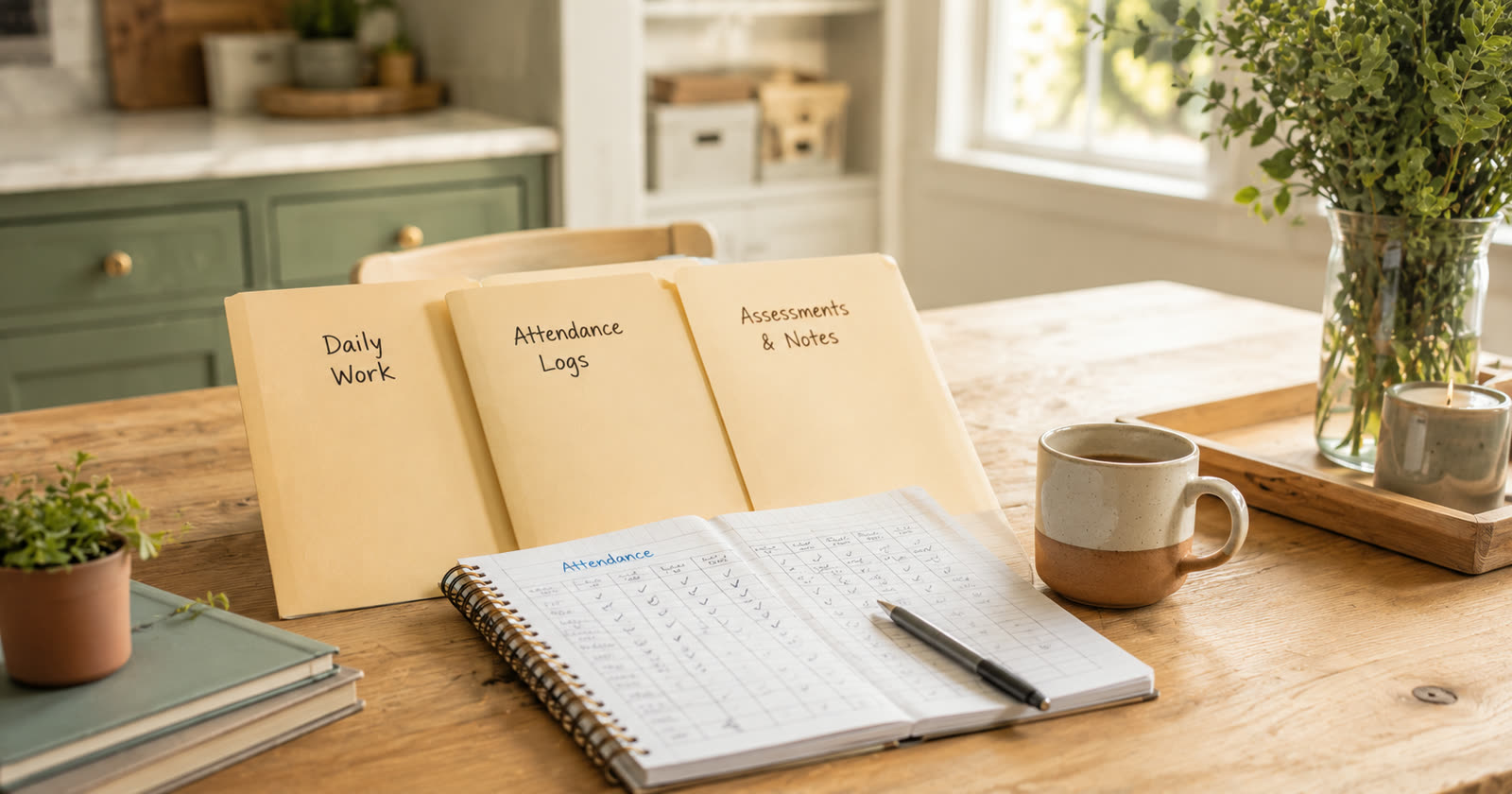
Texas law says you do not have to keep any homeschool records. Not attendance sheets. Not report cards. Not standardized test scores. Nothing gets submitted to the state, and no inspector visits your dining-room table. But if you ever need to enroll your child back in a Texas public school, apply to college, or simply quiet the 2 a.m. voice that asks whether you did enough, those records become your only proof. Here is exactly what homeschool records you need to keep in Texas, what you can safely skip, and the simple three-folder system I use so papers stop sliding under the car seats.
Does Texas require homeschool record keeping by law?
No. Texas treats homeschools as private schools. The Texas Education Agency does not require private schools—including home-based ones—to submit attendance, courses, grades, or test scores to any state agency. There is no mandated number of school days, and no portfolio review.
What Texas does require is that your program be bona fide. Under the Texas Supreme Court's decision in Leeper v. Arlington ISD, three things have to be true: the instruction is genuine rather than a sham to dodge compulsory attendance, it uses a curriculum in visual form (books, workbooks, written materials, video or online coursework — not speaking alone), and it covers five subjects: reading, spelling, grammar, mathematics, and good citizenship.
That is the whole legal bar, and if you are reading this and planning lessons, you almost certainly clear it. Note that science and history are not on the state's list, though colleges will expect them. For the full picture of the law itself, see our complete guide to homeschooling in Texas. The Texas Home School Coalition and HSLDA both maintain plain-English summaries if you want a second read.
What homeschool records should I keep in Texas anyway?
Even though the state asks for nothing, I keep five things. They take about ten minutes a week and have saved me twice—once when my daughter needed "proof of school" to audition for a regional theater program, and once when I realized at ten p.m. that scholarship applications wanted a reading list I had never written down.
| Record | Keep it? | Why it matters in Texas |
|---|---|---|
| Attendance log | Yes | Shows bona fide instruction; smooths re-entry to public school |
| Course list or subjects taught | Yes | Needed later for transcripts and some activity applications |
| Grades or assessments | Yes | Turns transcript writing from a nightmare into a twenty-minute task |
| Work samples / portfolio | Smart to keep | Backup if anyone questions progress |
| Standardized tests | Only if you test | Useful for college-bound students; not required by Texas |
| Reading list | Yes | Shows breadth; great for college apps and co-op placement |
| Extracurricular log | Yes | Scholarships and transcripts need these hours |
I do not save every math worksheet. That is a fast track to a closet that looks like a Staples warehouse explosion. I save one strong sample per quarter: a math test that shows mastery, one writing piece with the rough draft and final version, and a photo of the baking-soda volcano. If my child is in high school, I also keep a one-paragraph course description each semester so I am not guessing in twelfth grade whether biology included labs.
How do I track attendance for a Texas homeschool?
There is no minimum hour or day count in Texas. I still keep a simple attendance sheet because public schools may ask for it if you re-enroll mid-year. I print a one-page calendar, label it with my kid's name, and put an X through days we did school.
A "school day" in our house means we intentionally taught or learned something. Driving to the museum counts. Reading history on the couch counts. The doctor's appointment where we learned about white blood cells counts. I aim for about 180 marks because that is what colleges expect to see, but I do not stress if a December flu week stays blank.
What grades and tests do I need to save?
Only the ones you actually use. Texas does not require graded work, so if you are a Charlotte Mason family that narrates instead of testing, you are legally fine. I do assign grades starting in middle school because transcripts need them. If you want a simple approach, our homeschool gradebook applies whichever scale you choose without you having to hold it in your head.
If you choose to test, save the scores. The PSAT, SAT, ACT, and any annual standardized test you take should go in the "Keep Forever" folder. They are your easiest proof of academic progress. No test is mandated in Texas, but having scores on hand removes friction if you ever need to demonstrate readiness.
Do I need to keep a homeschool portfolio in Texas?
Not by law. But a slim portfolio is your best insurance. I keep one 1-inch binder per child per year. Inside: the attendance sheet, the reading list, four work samples, any test score printouts, and a one-page summary of what we studied.
If a school counselor ever asks, "How do I know your eighth grader is ready for ninth-grade work?" I hand over the binder instead of sweating through a verbal defense.
What if a Texas school district asks to see my records?
It is rare, but it happens if you re-enroll or if a truancy officer is confused about your status. Stay calm. Show your attendance log, your course list, and your portfolio. A district cannot demand a specific curriculum, test scores, or accreditation from a homeschool. If they push, the Texas Home School Coalition has a legal team that handles exactly this. Keeping those three folders close to your front door means you never have to ransack a garage at eight in the morning.
How long should I keep Texas homeschool records?
Through graduation, and then some. I keep elementary portfolios for two years after the next level begins, just in case we switch gears. I keep high school records permanently. Transcripts, course descriptions, and test scores live in a cloud folder and a fireproof file box.
You cannot recreate a homeschool transcript from memory once your teenager is applying to nursing school. If you are mapping out the whole year rather than just this week, our curriculum planner walks you through the big picture without the overwhelm.
What is the easiest way to organize Texas homeschool paperwork?
My paper system is ruthlessly simple because I will not spend Saturdays hole-punching. Three manila folders per kid: Current Year, Keep Forever, and Toss on June 1.
During the semester, everything lands in Current Year—worksheets, co-op newsletters, that watercolor of a cell. Once a month, while the kids eat lunch, I flip through and pull the four best samples and any test scores. Those migrate to Keep Forever. Anything that does not make the cut stays in Current Year until the first week of summer, at which point it hits Toss on June 1. I photograph anything sentimental, then I recycle. The whole ritual takes twenty minutes.
If you are digital-first, just name your cloud folders the same three labels and scan once a week while you drink coffee. Perfection is not the point. Findability is.
How do I make a homeschool transcript from my Texas records?
Good records make this easy. If you saved your course list and grades, you can make a homeschool transcript in about twenty minutes. Start in ninth grade. List each course, the credit earned, and the grade. Add standardized test scores and extracurricular hours.
Texas does not have an official homeschool transcript template, so a clean parent-generated document is fully legal and widely accepted.
If the day-to-day is the part that keeps slipping, our guide to building a homeschool schedule for multiple kids covers the routine that keeps records from piling up in the first place. And this is part of why I built ClassGenie—but the three-folder system works with or without it.
Frequently asked questions
Do I have to report my homeschool to the state of Texas?
No. Texas does not require homeschool registration, notification, or approval. You simply conduct a bona fide program in your home.
Can my child return to public school without homeschool records?
Usually, but the school may place your child based on age or require a placement test if you cannot show completed coursework. Keeping basic records smooths the transition.
Do Texas homeschoolers need to take the STAAR test?
No. STAAR is for Texas public school students only. Homeschooled students are not required to take any state standardized test.
What makes a homeschool bona fide in Texas?
Under Leeper v. Arlington ISD, the instruction must be genuine rather than a sham, it must use a curriculum in visual form such as books, workbooks, or online coursework rather than speaking alone, and it must cover five subjects: reading, spelling, grammar, mathematics, and good citizenship.
Should I create a homeschool diploma in Texas?
Yes, if your student is graduating from your homeschool. A parent-issued diploma is legal and accepted by Texas colleges and employers when backed by a transcript.
Texas gives you the freedom to homeschool without proving it to anyone. Records are not about satisfying the state. They are about making sure that on the day someone does ask—a registrar, an admissions office, or your own tired brain at 2 a.m.—the answer is already sitting in a folder.
Filing in another state? Our companion guides cover California homeschool record keeping requirements under the Private School Affidavit and what records to keep in Pennsylvania under Act 169.
— Laura, founder